





Common Coolant Flange Failures and How to Prevent Them
Coolant flange failures rarely happen without warning. They develop gradually — through heat cycling, material degradation, and the slow breakdown of sealing surfaces — until a visible symptom finally appears. By then, the damage has often been present for some time.
Knowing what to look for, and when to act, is what separates a repair that holds from one that comes back.
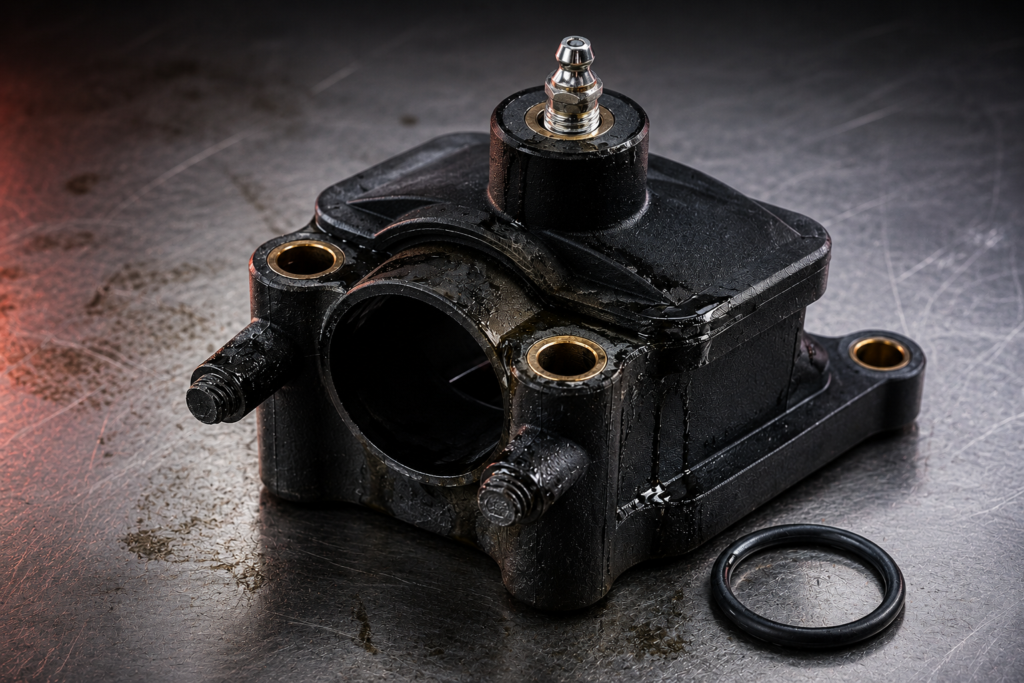
Know the Signs.
Avoid the Comeback.
Recognizing the Warning Signs
The earliest indicator of a failing coolant flange is coolant residue or staining around the housing joint. It is easy to dismiss this as a trace from a previous repair, but it typically signals that the sealing surface has started to lose contact with the gasket or O-ring.
Unstable engine temperature is another warning sign. When a flange is not sealing correctly, coolant loss or pressure instability can affect cooling system performance and may interfere with consistent thermostat operation. The engine may run warmer than expected, even with a recently replaced thermostat.Visible cracks, heat-related discoloration, or surface warping on the flange body are strong signs that replacement may be overdue.
Common Causes of Coolant Flange Failure
Poor sealing surface geometry is a common cause of repeat coolant leaks. Low-cost metal flanges may have poorly finished sealing faces, while molded plastic housings can have flash, warpage, or dimensional imperfections that prevent reliable contact with OEM-spec gaskets or O-rings. Under operating pressure, even minor surface imperfections can become leak paths.
Material degradation is particularly relevant in Europe, where OAT and HOAT coolant chemistry is standard across Volkswagen, BMW, Renault, and many others. Modern coolant environments expose flanges to hot water/glycol mixtures, coolant additives, pressure, and repeated thermal cycling, which can degrade unsuitable plastics over time. Swelling, cracking, and surface breakdown may follow, compromising the seal gradually rather than all at once.
Weld joint failure is a third common cause. Multi-piece housings with weak welds or inconsistent assembly joints can develop micro-leak points that widen under repeated thermal cycling. This type of failure is difficult to detect visually until it reaches an advanced stage.
Replace Thermostat and Housing Together
One common workshop mistake is replacing the thermostat while leaving an aged or worn housing in place. In many applications, these two components form a sealed unit in service. Separating their replacement is a frequent cause of cooling system leaks returning after repair.
A replacement coolant flange built to OE dimensions will fit accurately, accept standard gaskets straight from the box, and hold under pressure without shimming or sealer unless specified by the OE procedure. Correct installation — clean seating surface, new gasket, proper torque — completes the job.
From Diagnosis to the Right Replacement
Visual inspection covers most coolant flange issues. Check the sealing face for deposits or pitting, examine the housing body for cracks or warping, and inspect the gasket contact area for grooves or uneven wear.
When a fault is found — or when coolant loss continues after a thermostat replacement — replace the flange and thermostat together where the housing is aged, damaged, or supplied as an integrated assembly. In many applications, these two components work as a sealed pair. Replacing one while leaving a worn housing in place is a frequent reason cooling system leaks return after repair.
Choose a flange built to OE dimensions. It will fit without modification, accept standard gaskets straight from the box, and hold under full operating pressure. Always install with a clean seating surface, a new gasket, and correct torque.
Why Choosing the Right Part Matters
Low-cost flanges skip the manufacturing steps that matter most — precision machining of the sealing surface and material selection for real-world cooling environments.
MotoRad has supplied thermal management components to global OEMs — including Volkswagen, Audi, BMW, and Mercedes-Benz — since 1958. Every MotoRad coolant flange features precision-machined sealing surfaces, OE-grade materials validated for heat cycling and coolant chemistry, and full pressure, thermal, and leak testing before it leaves production.
With European operations near Cologne and coverage exceeding 90% of the European car park, MotoRad gives distributors and workshops a dependable source for cooling system repairs across all major vehicle applications.
Find the Right Coolant Flange for Your Application
Use the application search tool or contact your local representative at eu.motorad.com.
Trusted to Deliver Better
